Hockey jerseys are sized by the chest, measured over the pads you play in, then checked against body length. Top Notch hockey jerseys run men's XS to 4XL and youth XS to XL, and you confirm every player's size on the size chart and order form after you approve your free mockup. This hockey jersey size chart guide shows you how to measure a whole roster once and get it right the first time.
A hockey jersey size chart matches a chest measurement taken over your shoulder pads to a letter size: Top Notch hockey jerseys run men's XS to 4XL and youth XS to XL, and every player's size is confirmed on your order form after you approve the free mockup.
How are hockey jerseys sized?
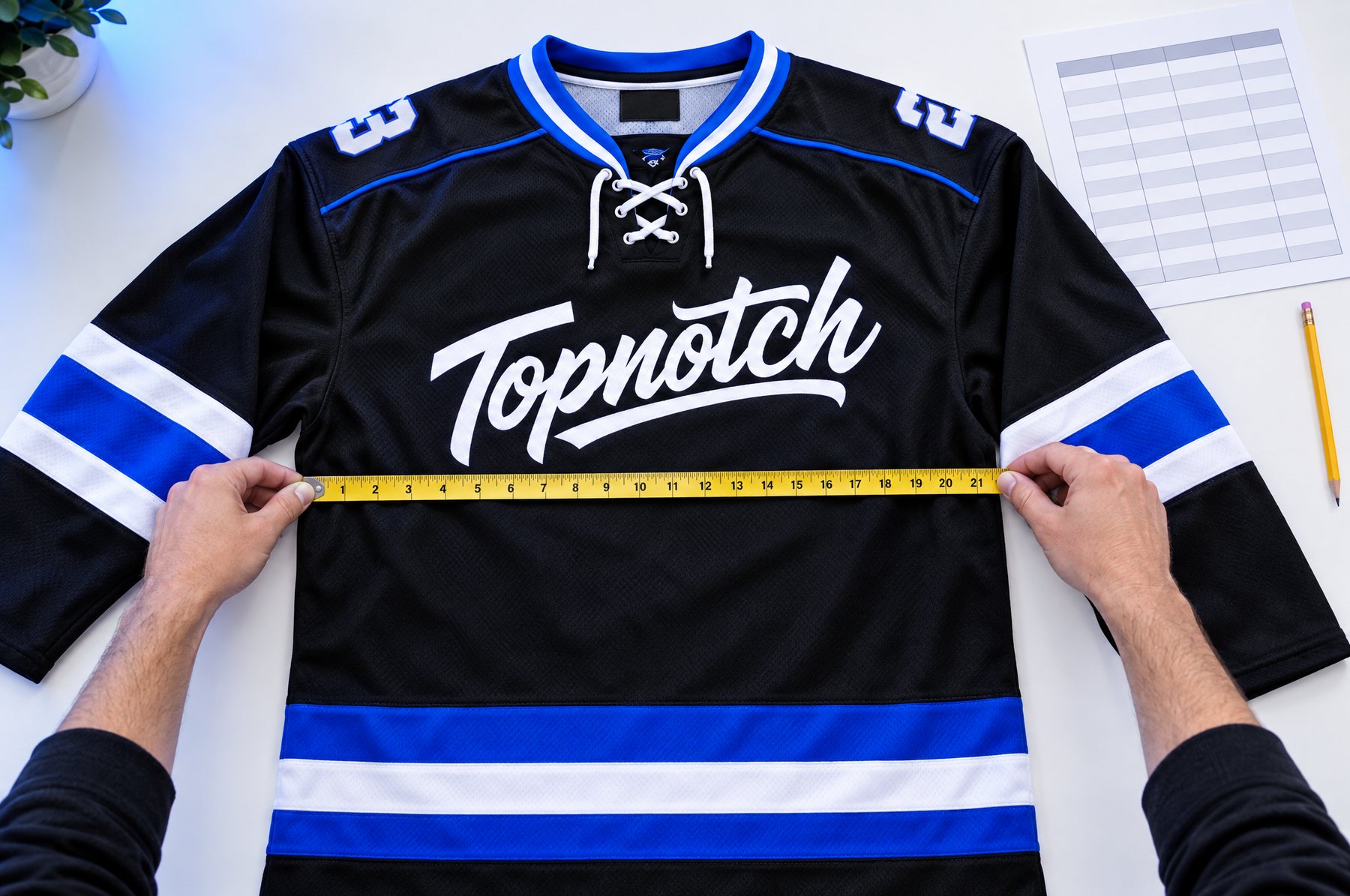
Every hockey jersey size chart starts with the chest. Your jersey has to clear shoulder pads, elbow pads and a chest protector for goalies, so the chest measurement that matters is the one you take with the pads on, not the one on your dress shirt. Body length comes second, because a hockey sweater needs to hang over the top of the pants without swallowing the player. Sleeve length comes third, and it is the number most teams forget until the elbow pads show.
Hockey jerseys come in two sizing languages. Letter sizes (youth S to adult 4XL) are what you find on team jerseys built for leagues, tournaments and rec play, including every Top Notch jersey. Numeric sizes (46, 50, 52 and so on) come from pro-style jersey lines and describe a nominal chest size with equipment on. Neither system is standardized between makers, which is why you measure the player and check the chart for the exact jersey you are ordering.
Garment makers build a chart by taking a body measurement and adding ease, the extra room that lets you move. The ASTM body measurement tables for adult men cover chest sizes from 34 to 52 inches and describe themselves as a baseline for designing apparel once you account for fabric type, ease for body movement, styling and fit. A hockey jersey sits at the roomy end of that spectrum: it is athletic wear cut to go over armour, so your chest number lands lower on the chart than it would for a fitted shirt.
What size is a 52 hockey jersey?
A 52 is a numeric size from the pro-style scale, and on most numeric scales it sits in the large range for an adult, so treat it as a rough guide to your player's chest. The number is meant to describe a chest size with pads on, but the scale drifts from one maker to the next, so a 52 from one jersey line does not measure the same as a 52 from another. Treat the number as a rough chest reading and nothing more.
To convert a numeric size to a letter size, measure the player instead of the old jersey. Take the chest with the pads on, note the body length of a jersey that fits well, and match both numbers to the letter chart of the jersey you are ordering. Your Top Notch designer works from those measurements, not from the number on a jersey you bought years ago.
If a player insists a 52 fits, measure that jersey flat: armpit to armpit across the chest, and collar seam to hem for length. Those two numbers move straight onto a Top Notch chart, because our charts list garment measurements, and you will land on the right letter size without guessing.
How do you measure a player for a hockey jersey?
You need a soft tape measure, the player's pads and five minutes at the rink. Measure over the base layer and the pads the player wears in games, keep the tape level and snug but not tight, and write the numbers down in inches, since Top Notch charts are in inches (2.54 cm per inch if your roster sheet is metric).
- Chest: wrap the tape around the fullest part of the chest with shoulder pads on, under the arms and across the shoulder blades. This is your primary number.
- Body length: measure from the top of the shoulder at the collar seam straight down to where you want the hem to fall, over the hockey pants. A jersey that stops at the top of the pants looks sharp and stays legal.
- Sleeve: run the tape from the centre back of the neck, over the shoulder and down to the wrist with elbow pads on. Sleeves that end short of the glove cuff show a bare forearm on every shot.
- Height and weight: record both as a cross-check, especially for youth players who are between sizes.
The chest number on a Top Notch chart is the garment measured flat, armpit to armpit, so double it to compare with the measurement you took around the player. A men's small T-shirt on our chart reads 21 inches across, which means a 42 inch circumference before ease. The apparel industry standardizes the names of these measurements through ASTM D5219, the terminology standard for body dimensions in apparel sizing, which is why chest, body length and sleeve length mean the same thing on every serious chart you will read.
There is a ceiling on how big you should go. The IIHF Official Rulebook 2025/26 (Rule 9.3) states that a skater's jersey must not extend lengthwise past the end of the pants and the sleeves must not extend past the fingers of the glove. Your league may not measure with a tape, but the rule is a good definition of a jersey that fits: hem at the pants, sleeves at the cuff, room to skate.
What sizes do Top Notch hockey jerseys come in?
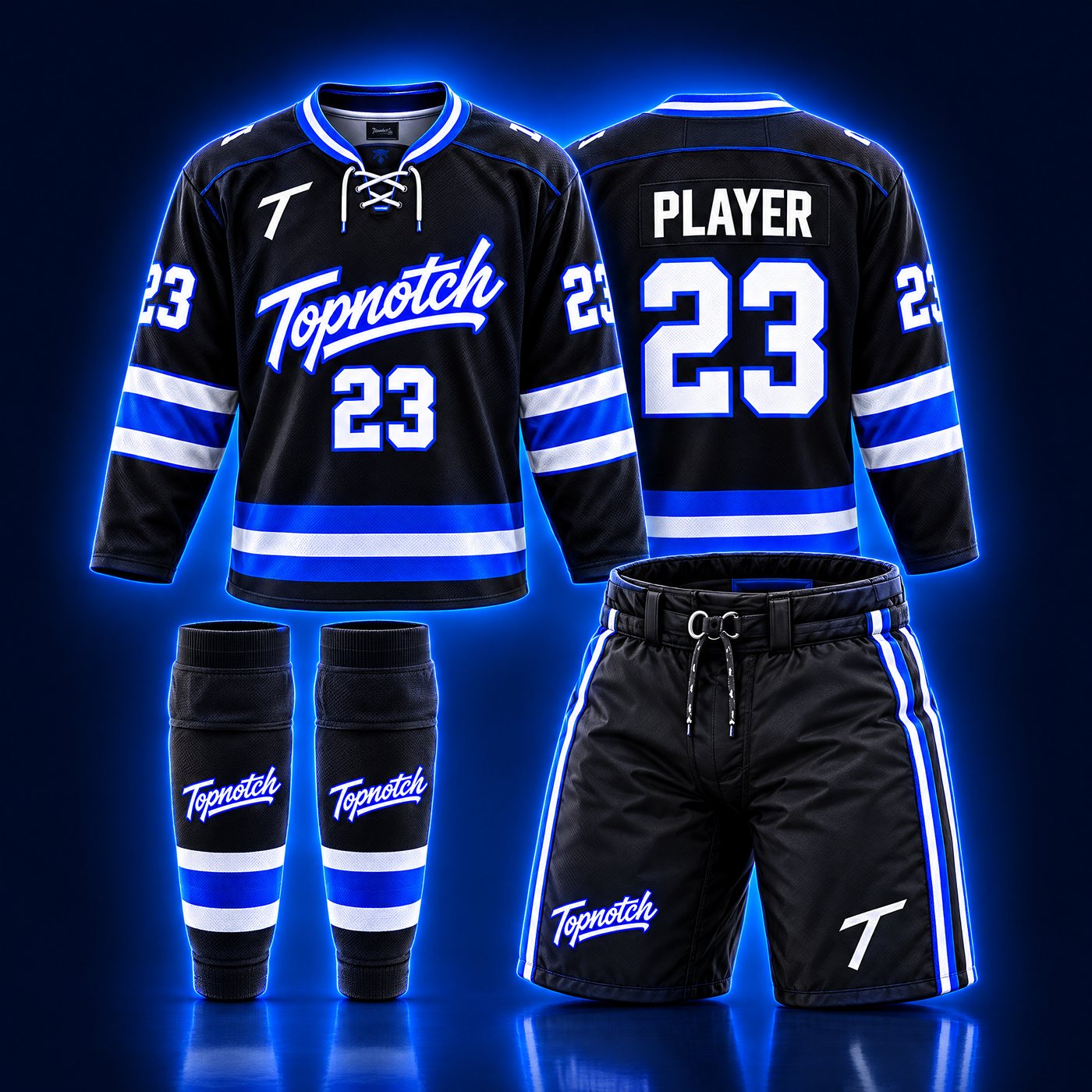
Top Notch Custom Hockey Jerseys run men's XS through 4XL and youth XS through XL, and every size carries the same sublimated design, the same lace-up collar with reinforced eyelets and the same reinforced flatlock stitching. The goalie cut is part of the same hockey line, and so are practice jerseys and hockey socks, so your whole hockey team orders from one mockup.
| Line | Sizes available | Who it fits |
|---|---|---|
| Men's ice hockey jersey | XS, S, M, L, XL, 2XL, 3XL, 4XL | Adult players in beer league, rep, junior and women's hockey |
| Youth ice hockey jersey | XS, S, M, L, XL | Minor hockey, spring hockey and house league players |
| Goalie cut | Same hockey line, sized over the chest and arm protector | Goalies at every level |
| Hockey socks | Sized by length, confirmed on your order form | Every player in the order |
Here is how sizing fits into your order. You send your colours, logo and roster and get a free mockup with unlimited revisions. Once you approve the design, you receive the size chart and order form for your exact style, fill in a size beside every player name, and production starts after payment. Nothing is cut until your sizes are on that form, which is the single best protection against a do-over before the first puck drops.
Goalies need their own line on the sheet. A goalie cut is wider through the chest and sleeves and longer in the body than a player cut, so measure your goalies over the chest and arm protector and read our guide to Goalie Cut vs Player Cut Jerseys before you fill in their sizes. Our Hockey Goalie Jerseys page shows the cut in your colours.
Is a youth XL the same as an adult small?
No. A youth XL is close to an adult small in width and shorter in the body, and the gap is bigger on the heavier garments your team orders. The cleanest way to see it is to put Top Notch's own charts side by side. These are our T-shirt and hoodie charts, the two garments a hockey team orders most often beside its sweaters, measured flat in inches.
| Top Notch chart | Size | Chest (flat) | Body length |
|---|---|---|---|
| T-shirt | Youth L | 19.5 | 25.5 |
| T-shirt | Youth XL | 20.25 | 27 |
| T-shirt | Men's XS | 20.25 | 27.5 |
| T-shirt | Men's S | 21 | 28.5 |
| T-shirt | Men's M | 21.75 | 30 |
| Hoodie | Youth L | 20 | 22 |
| Hoodie | Youth XL | 21 | 23 |
| Hoodie | Men's XS | 21 | 25.5 |
| Hoodie | Men's S | 22 | 26.5 |
| Hoodie | Men's M | 23 | 27.5 |
Read the T-shirt rows and you see the pattern: a youth XL and a men's XS share the same chest width, and the men's XS is half an inch longer. A men's small adds three quarters of an inch of width and a full inch and a half of length over the youth XL. On the hoodie the width story is the same, but the men's XS runs two and a half inches longer than the youth XL. Youth sizes are built for shorter torsos, so a young player who has grown into an adult chest usually needs adult length too.
Will a youth L or XL hockey jersey fit an adult on your roster? A small adult can wear a youth XL for a skate with no pads, but a game jersey has to cover shoulder pads and reach the glove, and the shorter youth body length and sleeves are where it fails. When a player sits between youth XL and adult S, order the adult S for hockey. Between youth L and youth XL, order the XL and let them grow into it.
What size hockey jersey does a 12-year-old need?
Most 12-year-olds land between a youth L and an adult S, and the only way to know which is to measure the chest with the pads on. Age is a poor guide at this stage. The ASTM body measurement tables for boys run from size 4 to size 20, cap out at age 15, and split every height into slim and regular builds, because two boys of the same height and age can need two different sizes. Your minor hockey roster is the proof: the same birth year can span three jersey sizes.
For growing players, size the chest first and then buy length. If the chest reads youth L but the player is tall for the age, take the youth XL for the extra body length and sleeve. If the chest reads adult S, go adult S even for a 12-year-old, because the shoulder width and sleeve length of an adult cut will fit the pads better than a stretched youth XL. Write the size beside the player name on your order form, then keep the roster sheet: your design stays on file with Top Notch, so a reorder for one player next season is a quick note, not a new project.
House league and spring teams that reorder every year should measure at the start of each season rather than copying your last sheet. A youth hockey jersey ordered in the right size lasts the season and stays in the family's hands as a keepsake instead of the lost-and-found bin. Our Minor Hockey and Rep Teams page shows what a full youth hockey order looks like.
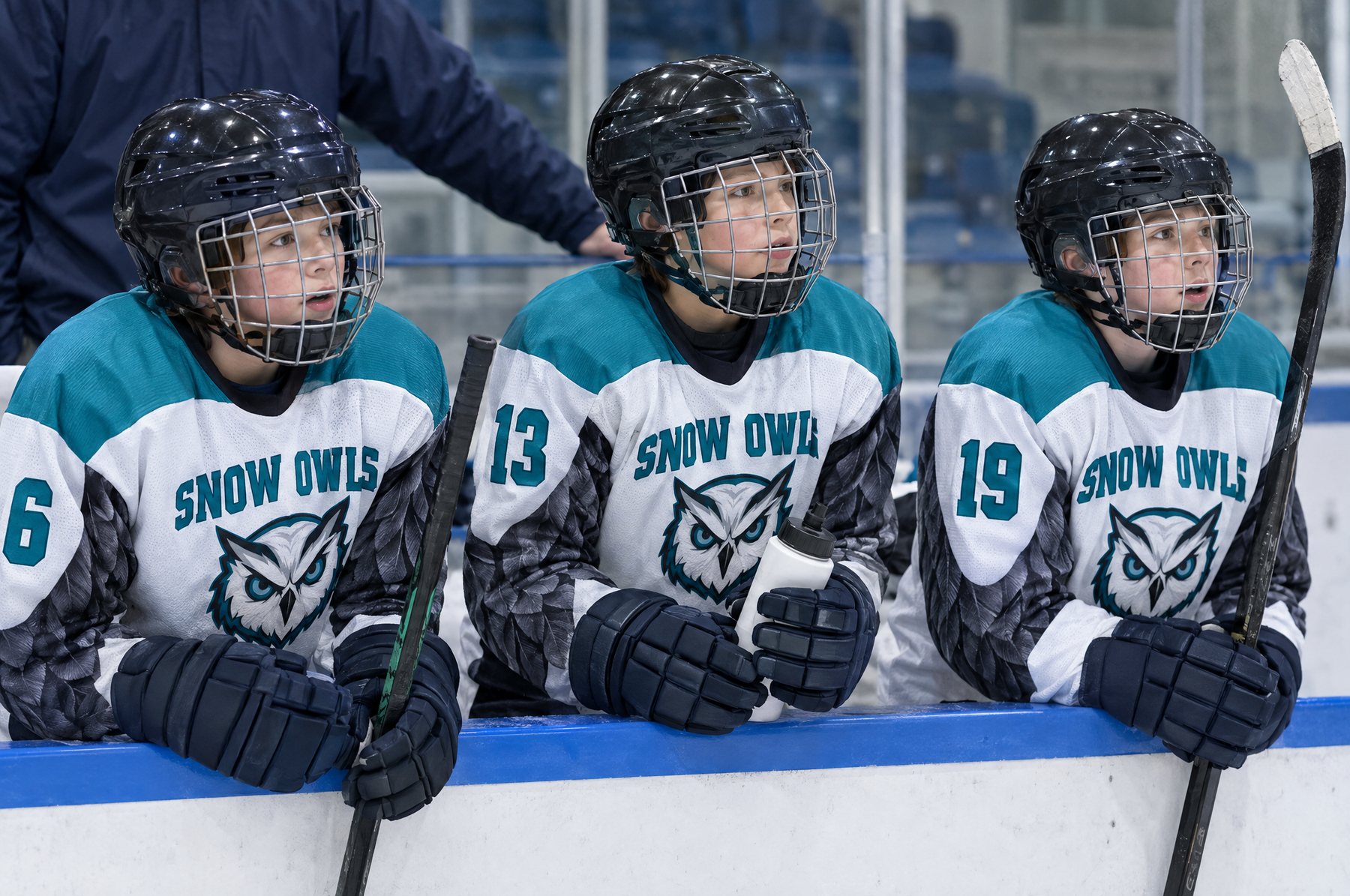
How do you use a hockey socks size chart?
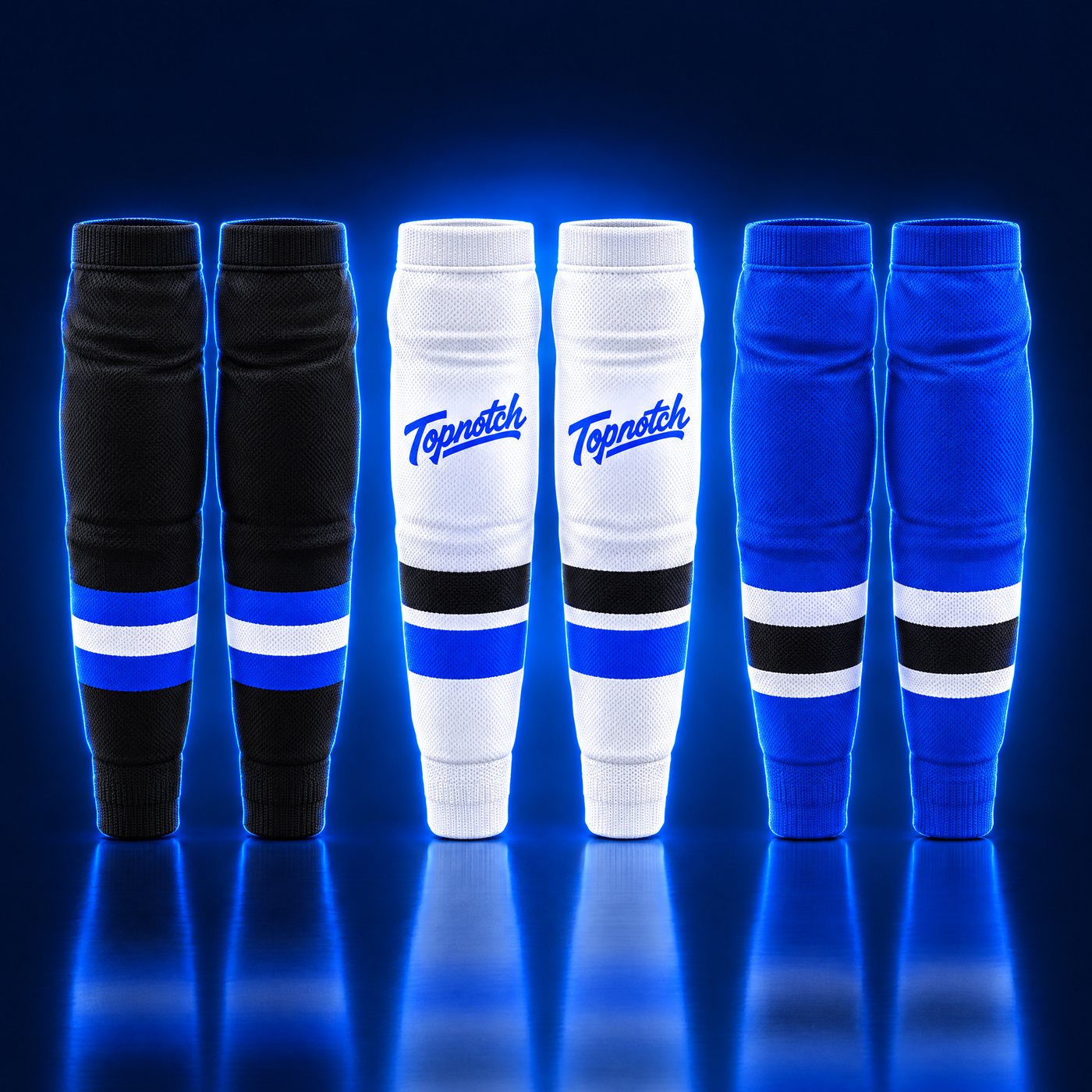
Hockey socks are sized by length, not by chest, because they run from the top of the skate boot to the thigh where the velcro tab or garter holds them. Measure from the top of the skate to the point on the thigh where the sock will attach, with shin guards on, and you have the number you need. Height drives the sock size more than weight does, so a lean tall player often needs a longer sock than a stocky player of the same jersey size.
On a Top Notch order, socks go on the same size chart and order form as your jerseys, so you pick a sock size beside each player name at the same time you confirm the jersey. Our Custom Hockey Socks are sublimated to match your jersey stripes and colours, which means a size run in the wrong length shows up on the ice as socks that bunch at the knee or ride up over the shin guard. Measure once, and every player in your team uniform looks finished from collar to skate.
How do you collect sizes from a whole team without a do-over?
Pick one practice, bring a soft tape and your printed roster, and measure every player in full pads before they hit the ice. Record chest, body length, sleeve, height and weight, then mark a jersey size and a sock size beside each name using the chart. Have a second parent read the tape so nobody guesses. Fifteen minutes on the bench saves a season of sleeves that stop short and hems that hang to the knees.
Here is why the measuring night pays off with Top Notch. Your free mockup shows your exact jersey in your colours with names and numbers, and you can revise it as many times as you need before you approve it. After approval you fill in the size chart and order form, and only then does production start: about two weeks, or 10 business days, after payment, with no rush option and no promised delivery date, so book your measuring night early. Every jersey is dye-sublimated, which means the colours never crack, peel or fade, and your design stays on file for easy reorders when a new player joins mid-season.
Ready to put your roster in the right sizes? Send your colours, logo and roster through the form on this page and a Top Notch designer replies within 1 business day with your free mockup. Measure the players, approve the design, and let your custom jersey order arrive ready for the first game.
Questions about hockey jersey size chart
What size is a 52 hockey jersey?
A 52 is a numeric size from pro-style jersey lines and sits in the large range on most scales. The number is not a body measurement and it is not standardized between makers, so measure the player's chest over the pads and match it to the letter chart of the jersey you are ordering.
How do they size hockey jerseys?
By chest first, then body length, then sleeve, all measured with the pads on. Team jerseys use letter sizes, youth XS to XL and men's XS to 4XL at Top Notch, and each letter covers a range of chest measurements with ease built in for movement.
Will a youth L or XL hockey jersey fit an adult?
A youth XL matches a men's XS in chest width on Top Notch's T-shirt chart, but it runs shorter in the body and sleeves. For hockey with pads, a small adult should order a men's S so the hem reaches the pants and the sleeves reach the glove.
Is a youth XL jersey larger than a men's small?
No. On Top Notch's T-shirt chart a youth XL measures 20.25 inches across the chest and 27 inches long, while a men's small measures 21 by 28.5 inches. The men's small is wider and longer, and the gap in length grows on hoodies and jerseys.
Should I order hockey jerseys a size up?
Order the size the chest measurement over pads points to, and go up only when the player is between sizes or still growing. Oversized jerseys catch sticks, hang past the pants and break the IIHF fit rule that a jersey must not extend past the end of the pants.
Do goalie cut jerseys use the same size chart?
Goalies use the same letter sizes, but you measure them over the chest and arm protector, and the goalie cut is wider through the chest and sleeves and longer in the body. Mark your goalies on the order form so they get the goalie cut, not a player cut two sizes up.
What happens if I get a size wrong on my order form?
Sizes you approved on the mockup and order form are not manufacturing errors, so custom jerseys in the wrong size cannot be exchanged. Measure with the pads on, have a second person read the tape, and check every line of the form before you sign off.
Sources
- ASTM D6240/D6240M-24a, Standard Tables of Body Measurements for Adult Male, Chest Size Range 34 to 52 Short, Regular, and Tall, ASTM International (verified 2026-09-26)
- ASTM D5219-25, Standard Terminology Relating to Body Dimensions for Apparel Sizing, ASTM International (verified 2026-09-26)
- ASTM D6458/D6458M-19, Standard Tables of Body Measurements for Boys, Sizes 4 to 20 Slim and 2 to 20 Regular, ASTM International (verified 2026-09-26)
- IIHF Official Rulebook 2025/26, Rule 9.3 Skater's Jersey, International Ice Hockey Federation (verified 2026-09-26)
- Top Notch Sports size charts (T-shirt and hoodie, garment measurements in inches), Top Notch Sports (verified 2026-09-26)
About Top Notch Sports
Top Notch Sports makes fully sublimated custom team uniforms for 20 sports, hockey first. Every team gets a free mockup before paying, unlimited revisions, and a design kept on file for reorders. See the hockey line or start your free mockup.